UConn Husky Nutrition & Sport operates as a campus-community partnership striving towards:
- right relationships
- shared learning
- collaborative and sustained partnerships
- student-family-community health and wellness
- relevant, representative, and impactful curriculum
- equity-focused values and practices
- student and community workforce development
- various forms of community-centered evaluation and academic scholarship
Founded in 1994, Husky Nutrition began as a statewide initiative of the University of Connecticut focused on nutrition education and obesity prevention through federal funding from the United States Department of Agriculture (USDA), Supplemental Nutrition Assistance Program – Education (SNAP-Ed). In 2003, Husky Sport was established with an intentional focus on Hartford’s North End, using sport-based youth development, racial equity frameworks, and service-learning courses to connect university students and staff with community partners to address their priorities. These complementary efforts—one emphasizing statewide health promotion and the other with in-depth Hartford Public School and surrounding neighborhood engagement—merged in 2021 to form UConn Husky Nutrition & Sport.
UConn HNS is housed in the Neag School of Education at the University of Connecticut. Participating university stakeholders work across disciplines and communities as part of collaborative partnerships and direct education programs. UConn HNS provides scaffolded opportunities for personal and professional development via academic courses, internships, graduate assitantships, and research.
“The sustained efforts of Husky Nutrition & Sport are rare to see. We are often told by our partners that so many university-based programs come and go. We remain committed not only to continuing partnerships with individuals, organizations, and communities, but also to evolving our approaches to prioritize relationships, recognizing the strengths of everyone involved, and celebrating culture as part of our collaborations.”
- Dr. Jennifer McGarry, UConn HNS Founder
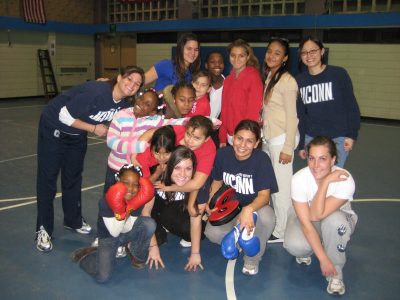
Initial Pilot Program funded by City of Hartford for Girls Afterschool Program (2005)
Relationships
reciprocal campus-community partnerships built on respect and “right” relationships, where one treats individuals as equal authorities on their own lives. In doing so, we challenge inequitable individual behaviors and social structures.
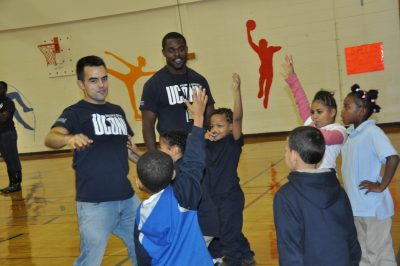
Hartford Public Schools Partnership started with PE Class visits and UConn student volunteers (2008)
Relevancy
programs and partnerships designed based on the specific needs and interests of participants and partners to support nutrition and physical activity education and engagement across the lifespan.
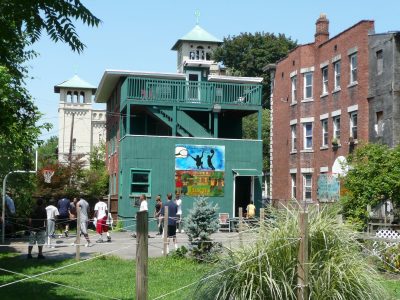
20+ year partnership for community building at the Hartford Catholic Worker on Clark Street (2006)
Representation
talented partners, college students, and staff with diverse identities and experiences working in collaboration and towards enhanced equity-focused values and practices as engaged professionals and community members.
Foundational Frameworks
Campus Community Partnership
Too often is the case where campus-community partnerships are based upon a model that operates with university stakeholders as experts approaching communities as problems to fix (Boyer, 1990). Specific examples of inequitable collaboration have been observed in decision-making and short term programs driven by funding and its accompanying rules (Bringle & Hatcher, 2002). Instead, working groups with stakeholders of diverse identities and roles, can operate within a web of active relationships and partnerships with complex dynamics that require effective management and on-going analysis (Sandy & Holland, 2006; Dotterweich, 2006; Walsh, 2006).
Communities of Practice
UConn HNS looks to capitalize on the benefits of cultivating communities of practice as a vehicle for formal professional development on UConn’s campus and alongside partners in Hartford and across the state of Connecticut.
Communities of practice are everywhere; in our workplaces, schools, and within social settings (Clayton & Cuddapah, 2011). In some we are core members and have a voice in determining the direction of the community, while in others we are on the sidelines occupying the role of the observer, taking in information with less of an active role, but still feeling influenced by our participation in the community of practice. The primary focus of community of practice as a concept is on learning as social participation, looking at participation as engagement in events and certain activities (practice) with certain people (community), but also as the process of being active participants in practices of a social community and constructing identities in relation to these communities (Wenger, 1998).
Critical Service Learning
Critical Service Learning informs collaborative partnerships and shared learning between community participants, partners, professional staff, and college students. Rather than engaging in service and engagement with a savior mentality, critical service learning focuses on authentic relationship building, a social change orientation, and working to redistribute power among diverse participants (Mitchell, 2008).
Citations: Mitchell, 2008; Add more when ready; What is Critical Service Learning?; Building Relationships for Critical Service Learning; Critical Information Literacy and Critical Service Learning
USDA MyPlate
UConn HNS utilizes the MyPlate framework to guide direct education curriculums and engagements with community members. The U.S. Department of Agriculture (USDA) created MyPlate, an easy-to-follow food guide, to help parents to figure out how to feed their kids nutritious, balanced meals.
The colorful divided plate includes sections for vegetables, fruits, grains, and protein foods. MyPlate's user-friendly, interactive website provides simple messages, such as:
- choose variety — the best meals have a balance of items from different food groups
- fill half your child's plate with vegetables and fruits
- make at least half the grains you serve whole grains, like oatmeal, whole-wheat bread, and brown rice
- serve fat-free or low-fat (1%) milk and water rather than sugary drinks
- don't serve oversized portions
Social Ecological Model
The social ecological model is a framework that examines how multiple levels of influence interact to shape individual and community behaviors. It consists of five interconnected layers: the individual, interpersonal relationships, community and organizational factors, societal norms, and government policies. This model helps understand how these factors contribute to health and well-being, making it a valuable tool in public health and social science research.
Sport Based Youth Development
Husky Sport employs the conceptual and practical components of the Sport Based Youth Development (SBYD) framework to inform stakeholder teaching and learning within a campus-community partnership. Working to provide a larger system of support for youth development and youth development practitioners, SBYD outlines an avenue for positive relationship building and collaborative network development amongst diverse community members (Sherry, Karg, & O’May, 2011; Smith & Westerbeck, 2007). With sport as an initial hook (Perkins & Noam, 2007) for shared participation in physical activity, Husky Sport programs and partnerships also engage curriculum focused on youth attainment of knowledge and application of healthy nutrition, transferable life skills, and academic enrichment.
Learn more about our Sport Based Youth Development framework
-

The UConn Husky Nutrition & Sport initiative connects UConn students with hundreds of young children across the state each year
- columns: 1
- pictures: on
- number-of-posts: 1
- post-slugs: husky-reads-brings-the-joy-of-reading-and-healthy-lifestyles-to-connecticut-preschoolers
- read-more-text: Read More
- show-excerpt: on
- safe-fetch: 1
- attempted-request: https://today.uconn.edu/wp-rest/wp/v2/posts?posts_per_page=1&slug=husky-reads-brings-the-joy-of-reading-and-healthy-lifestyles-to-connecticut-preschoolers&adjacent-posts=true&_embed
-

UConn Husky Nutrition & Sport, a merger of two SNAP-Ed programs, launches new website and sets high goals for its next phase of community and campus engagement
- columns: 1
- pictures: on
- number-of-posts: 1
- post-slugs: twenty-years-of-nutrition-and-physical-education-in-connecticuts-communities/
- read-more-text: Read More
- show-excerpt: on
- safe-fetch: 1
- attempted-request: https://today.uconn.edu/wp-rest/wp/v2/posts?posts_per_page=1&slug=twenty-years-of-nutrition-and-physical-education-in-connecticuts-communities%2F&adjacent-posts=true&_embed
-
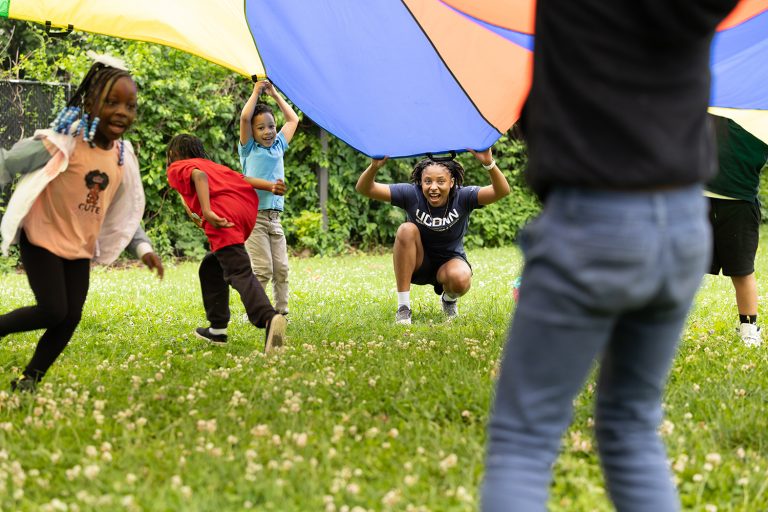
The UConn campus-community partnership hosts more than 600 educational sessions a year at Fred D. Wish Museum School
- columns: 1
- pictures: on
- number-of-posts: 1
- post-slugs: a-vibrant-partnership-uconn-husky-nutrition-sport-and-hartford-public-schools-support-healthy-eating-and-physical-activity-for-over-20-years
- read-more-text: Read More
- show-excerpt: on
- safe-fetch: 1
- attempted-request: https://today.uconn.edu/wp-rest/wp/v2/posts?posts_per_page=1&slug=a-vibrant-partnership-uconn-husky-nutrition-sport-and-hartford-public-schools-support-healthy-eating-and-physical-activity-for-over-20-years&adjacent-posts=true&_embed
-
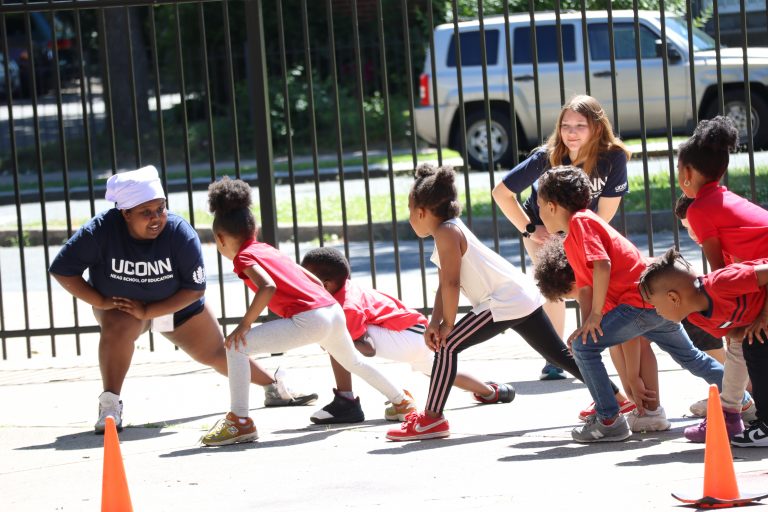
The renewal of USDA funding will support the initiative for the next three years
- columns: 1
- pictures: on
- number-of-posts: 1
- post-slugs: uconn-husky-nutrition-sport-receives-4-9m-in-federal-funding
- read-more-text: Read More
- show-excerpt: on
- safe-fetch: 1
- attempted-request: https://today.uconn.edu/wp-rest/wp/v2/posts?posts_per_page=1&slug=uconn-husky-nutrition-sport-receives-4-9m-in-federal-funding&adjacent-posts=true&_embed